
Elasmobranchs on the Move
How are Warming Seas Shaping Sharks and Ray Behaviour in the Canary Islands?
The Canary Islands currently stand as a key refuge for elasmobranchs in the Atlantic, with over 56 shark species and numerous rays inhabiting their diverse waters (Varela et al., 2025). As ocean temperatures continue to rise, these species are beginning to alter their behaviour and distribution, offering both a warning signal and a valuable chance to study marine adaptations. This makes the archipelago an exceptional natural laboratory for studying elasmobranch ecology and guiding conservation strategies in a changing climate (Moreno et al., 2022).
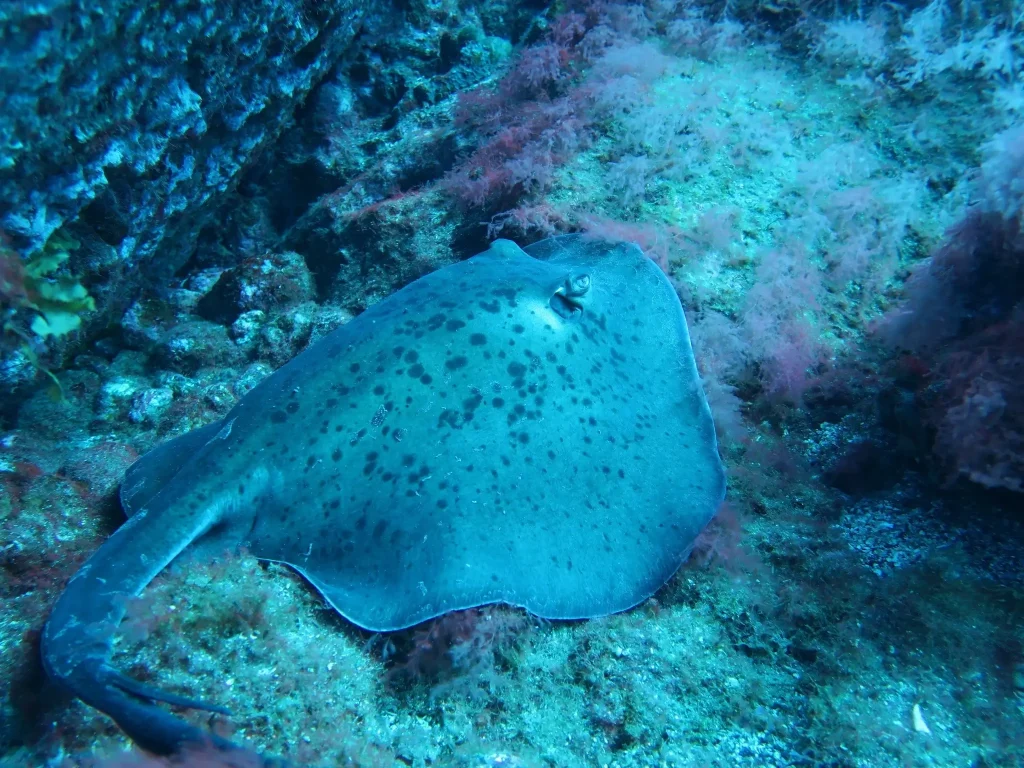
Photo of a devil ray (Mobula mobular) © SP Mac, used with permission via Flickr.
Why are elasmobranchs Important?
Elasmobranchs, the group of cartilaginous fishes that includes sharks and rays, are vital components of marine ecosystems. As top predators, they help maintain ecological balance across food webs, and their decline can trigger trophic cascades – chain reactions in which changes at the top of the food web spread through many other species (Myers et al., 2007).
In the Canary Islands, where many vulnerable and endangered species persist, understanding their ecology and behaviour is crucial for conservation. This research supports the work of organisations, such as Latitud Azul and the Angel Shark Project, which are developing strategies to safeguard these species under increasing human and climate pressures (Moreno et al., 2022).
The archipelago is also notable for its diversity: eagle rays (Myliobatis aquila) glide over sandy reefs, gulper sharks (Centrophorus granuloses) patrol the deep Atlantic slopes, and even devil rays (Mobula mobular) occasionally pass through (Tuya et al., 2021). Most iconic, however, are the angelshark (Squatina squatina), which has its last stronghold here, and the spiny butterfly ray (Gymnura altavela), known for its striking seasonal gatherings. It is also one of the few places in the world where the smalltooth sand tiger (Odontaspis ferox) is regularly observed, appearing around El Hierro roughly every four years.
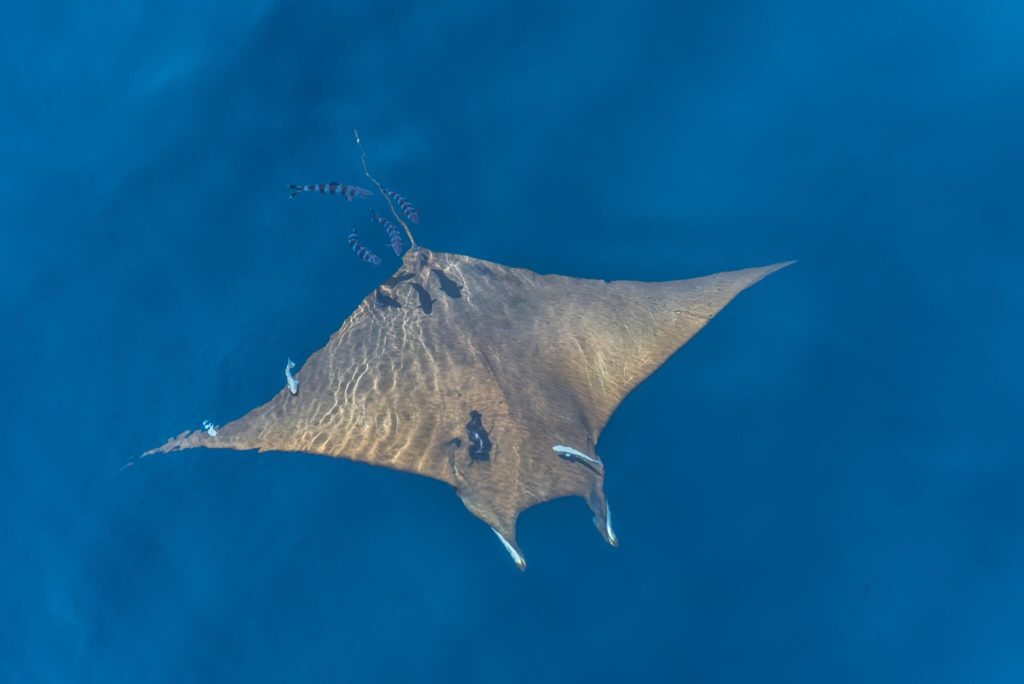
Photo of a devil ray (Mobula mobular) © SP Mac, used with permission via Flickr.
Key Threats
Elasmobranchs in the Canary Islands face multiple pressures. Habitat loss from coastal development (Riera et al., 2014), fishing pressure from both recreational and commercial activities (Mendoza et al., 2018) and rising pollution levels (González et al., 2025) all contribute to population declines. Climate change is intensifying the problem, with warming seas already altering behaviour and distribution in ways that may disrupt reproduction and connectivity (Mead et al., 2025). Even tourism plays a double role: while it can raise awareness and supports protection, irresponsible practices such as chasing or feeding animals can cause stress. Many elasmobranchs remain unprotected from sport fishing, with some charter companies even targeting them, adding further pressure to already declining populations.
The Critically Endangered Angelshark (Squatina squatina)
Once widespread across European waters, S. squatina has declined by more than 80% in the last three generations, largely due to accidental bycatch in bottom trawls and gillnets (Barker et al., 2016). Today, the Canary Islands represent its last stronghold, where both angelsharks and spiny butterfly rays benefit from the absence of bottom trawling.
Recognising this vulnerability, Spain granted S. squatina full legal protection in 2019 under the category “in danger of extinction,” building on earlier fisheries restrictions introduced in 2009.
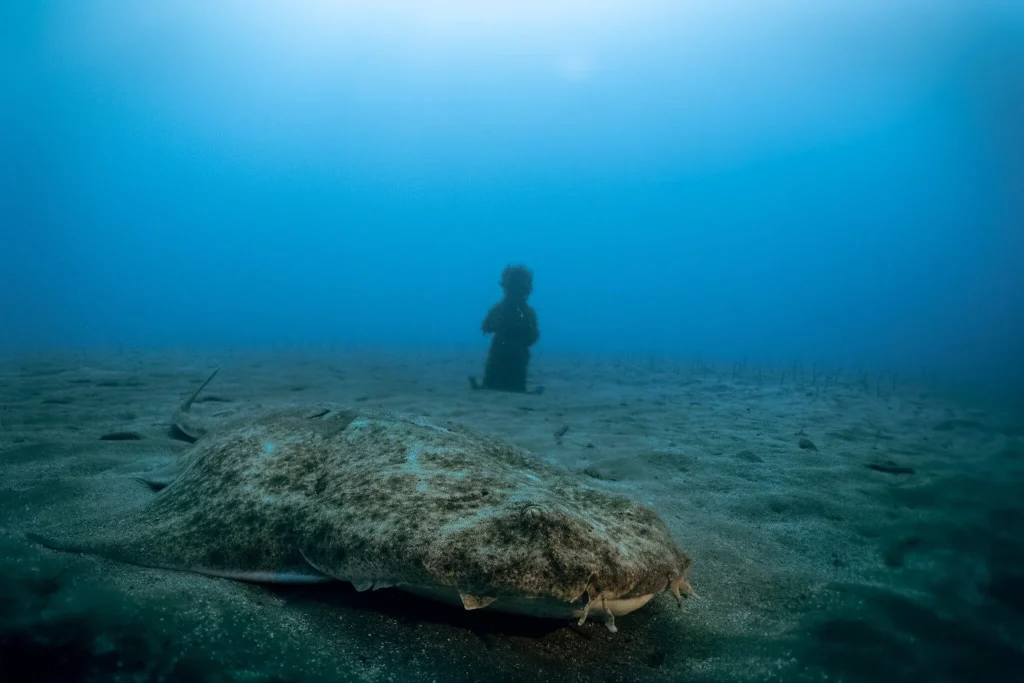
Photo of an Angelshark (S. squatina).
Captured by Alfredo de la Moneda, Innoceana.
To understand how angelsharks are responding to a changing ocean, researchers are using a combination of methods including acoustic telemetry, genetic studies, citizen science and photo-ID (Fitzpatrick et al., 2017; Noviello et al., 2021; Meyers et al., 2024; Mead et al., 2025). A milestone came in 2017, when the first complete mitochondrial genome of the species was sequenced from a specimen collected in Gran Canaria, providing an essential reference for population genetics (Fitzpatrick et al., 2017).
More recently, a 2025 study revealed that during the exceptionally warm summer of 2022, females almost completely avoided breeding grounds once sea temperatures exceeded 22.5 °C, while males continued to return (Mead et al., 2025). This sexually divergent behaviour highlights their sensitivity to warming seas, while giving conservationists clearer guidance on the conditions angelsharks need to thrive. Protecting cooler refuges and key habitats may be critical to securing the future of one of the world’s rarest sharks.
The Spiny Butterfly Ray (Gymnura altavela)
In the Canary Islands, the vulnerable G. altavela offers another example of sex-specific responses to temperature. A recent study found that this species forms large seasonal aggregations of mostly females in Tenerife, with sightings closely tied to water temperatures of 22-24 °C (Espino-Ruano et al., 2023). Unlike angelsharks, where females avoid warmer waters, female G. altavela appear to seek them out, likely as part of their breeding cycle.
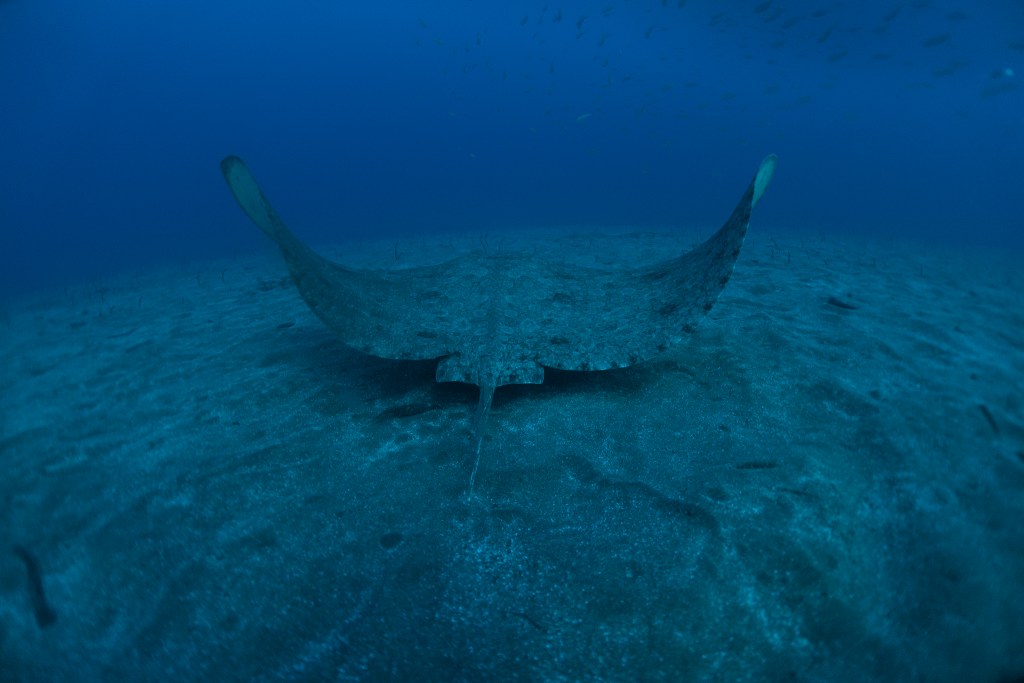
Photo of a Spiny Butterfly Ray (G. altavela).
Captured by Alfredo Moneda, Innoceana.
These contrasting behaviours show how warming seas can shape species in very different ways. For G. altavela, dependence on narrow thermal windows suggests that future shifts in sea temperatures could directly affect their reproduction (Espino-Ruano et al., 2023). Ongoing research is also expanding knowledge of the butterfly ray’s health, reproduction and movement, using innovative tools such as ultrasound and acoustic tagging (CanBio, 2022). Understanding such behaviours is vital for anticipating how rays and other coastal elasmobranchs may adapt, or struggle, in a rapidly changing Atlantic.
Research on S. squatina and G. altavela reminds us that even closely related species can follow very different paths in a changing ocean. By learning from these patterns, we have the chance to shape conservation that truly works with nature. Citizens can also contribute by reporting elasmobranch sightings through REDPROMAR, providing crucial data to support ongoing protection efforts. With continued research, local stewardship and global awareness, the Canary Islands can stand as a refuge of resilience, showing that sharks and rays are not only survivors of the past, but part of the ocean’s future.
Bibliography:
- (2022, October 5). The CanBIO project progresses with a ground-breaking study of butterfly rays in Canary Islands waters. IN ECOAQUA News, BIOCON News. Retrieved September 12, 2025.
- Fitzpatrick, C. K., Finnegan, K. A., Osaer, F., Narváez, K., & Shivji, M. S. (2017). The complete mitochondrial genome of the critically endangered angelshark, Squatina squatina. Mitochondrial DNA Part B, 2(1), 212–213.
- Mead, L. R., Piper, A., Alvarado, D. J., Meyers, E., Barker, J., Toledo‐Padilla, H., Herraiz, E., Campoamor, A. F., Sealey, M., Caro, M. B., Bañeras, T., Pike, C., Gollock, M., Ravina‐Olivares, F., & Jacoby, D. M. P. (2025). Rapid ocean warming drives sexually divergent habitat use in a threatened predatory marine ectotherm. Global Change Biology, 31(7).
- Mendoza, J. C., Dorta, C., Brito, A., & Hernández, J. C. (2018). Elasmobranch bycatch on artisanal trammel net fishery in the Canary Islands. Scientia Insularum. Revista de Ciencias Naturales En Islas, 1, 87–102.
- Meyers, E. K. M., Faure, N., Jiménez-Alvarado, D., Barker, J., Toledo-Padilla, H., Tuya, F., Pike, C., Mead, L. R., Sealey, M. J., Caro, M. B., Jacoby, D. M. P., Ravina Olivares, F., Bañeras, T., Guerra-Marrero, A., Espino-Ruano, A., Castro, J. J., Bousquet, C., Giovos, I., Rödder, D., & Manel, S. (2024). Distinct management units for the Critically Endangered angelshark (Squatina squatina) revealed in the Canary Islands. Conservation Genetics, 26(1), 103–116.
- Moreno, J., Solleliet-Ferreira, S. E., & Riera, R. (2022). Distribution and abundance of coastal elasmobranchs in Tenerife (Canary Islands, NE Atlantic Ocean) with emphasis on the bull ray, Aetomylaeus bovinus. Thalassas: An International Journal of Marine Sciences, 38(1), 723–731.
- Myers, R. A., Baum, J. K., Shepherd, T. D., Powers, S. P., & Peterson, C. H. (2007). Cascading effects of the loss of apex predatory sharks from a coastal ocean. Science, 315(5820), 1846–1850.
- Noviello, N., McGonigle, C., Jacoby, D. M. P., Meyers, E. K. M., Jiménez‐Alvarado, D., & Barker, J. (2021). Modelling critically endangered marine species: Bias‐corrected citizen science data inform habitat suitability for the angelshark (Squatina squatina). Aquatic Conservation: Marine and Freshwater Ecosystems, 31(12), 3374–3389.
- Riera, R., Becerro, M. A., Stuart-Smith, R. D., Delgado, J. D., & Edgar, G. J. (2014). Out of sight, out of mind: Threats to the marine biodiversity of the Canary Islands (NE Atlantic Ocean). Marine Pollution Bulletin, 86(1–2), 9–18.
- Tuya, F., Aguilar, R., Espino, F., Bosch, N. E., Eva, Jiménez‐Alvarado, D., Castro, J. J., Otero‐Ferrer, F., & Haroun, R. (2021). Differences in the occurrence and abundance of batoids across an oceanic archipelago using complementary data sources: Implications for conservation. Ecology and Evolution, 11(23), 16704–16715.
- Varela, J., Santos, C. P., Nunes, E., Pissarra, V., Pires, S., Ribeiro, B. P., Vieira, E., Repolho, T., Queiroz, N., Freitas, R., & Rosa, R. (2025). Sharks in Cabo Verde, Canarias, Madeira and Azores islands: Species richness, conservation status and anthropogenic pressures. Frontiers in Marine Science, 12, 1490317.
- Barker, J., Bartoli, A., Clark, M., Dulvy, N. K., Gordon, C., Hood, A., Alvarado, D. J., Lawson, J., & Meyers, E. (2016). Angelshark action plan for the Canary Islands. ZSL, 2, 3.