
Anthropogenic Impact of Loggerhead Turtles in the Canary Islands
What is a loggerhead turtle and where can it be found?
The loggerhead turtle (Caretta caretta), listed as Vulnerable on the IUCN Red List (IUCN, 2007; Casale & Marco, 2015), is one of the seven species of sea turtles that inhabit our oceans. It is widely distributed across temperate and subtropical waters worldwide, spanning the Atlantic to the Pacific and Indian Oceans (Wallace et al., 2010; D’Ilio et al., 2011).
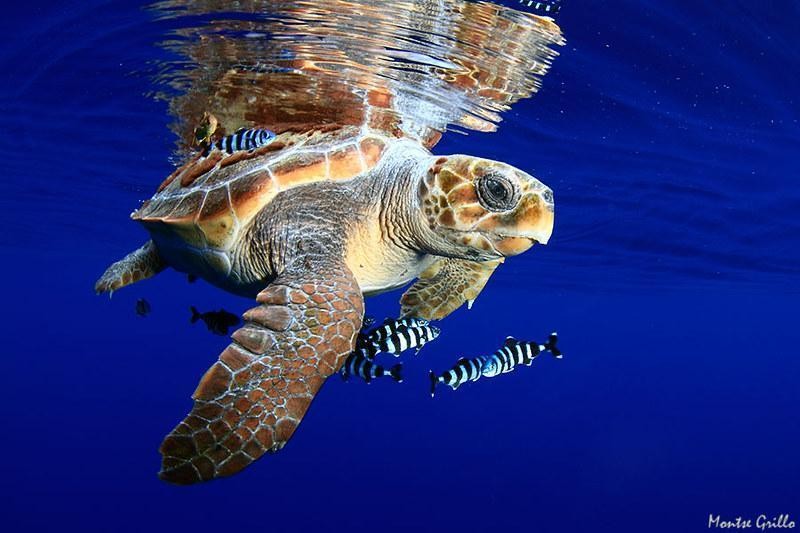
Loggerhead turtle (Caretta caretta). Photograph by Montse
In the North Atlantic, hatchlings emerge from beaches primarily in Florida (Brost et al., 2015) and Cape Verde (Martins et al., 2022), with additional contributions from Mexico (González et al., 2020). Carried by ocean currents, they travel to developmental zones such as the Azores, Madeira, or the Canary Islands (Monzón-Argüello et al., 2009; Tortosa García de Ceca, 2021). The early juvenile oceanic (pelagic) phase can last several years, in some cases over a decade (Bjorndal et al., 2000) and is often associated with Sargassum mats and open‑ocean currents (Witherington et al., 2012). As they grow larger, juveniles gradually undergo an ontogenetic habitat shift into neritic (coastal) waters, where they feed on benthic prey. Adults continue to use neritic habitats for foraging and undertake seasonal migrations to their natal beaches to reproduce, a process commonly known as natal homing (McClellan & Read, 2007; Ministerio para la Transición Ecológica y el Reto Demográfico, 2022).
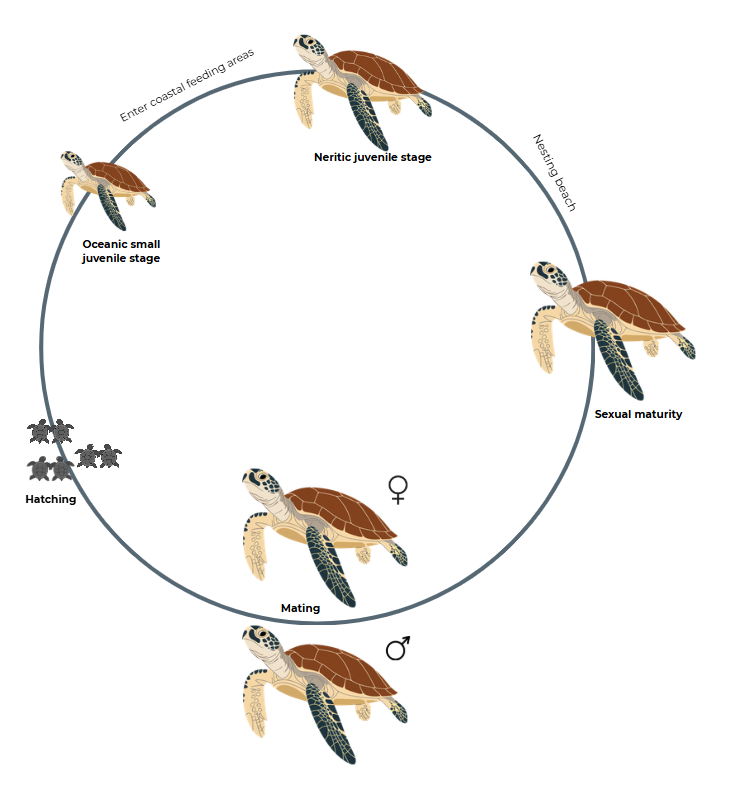
Life cycle of the loggerhead turtle (Caretta caretta), illustrating the main developmental stages
Why are loggerhead turtles important for ocean connectivity?
In the Atlantic, for example, this life cycle connects distant marine ecosystems through long-distance migrations and shared population units, and similar patterns are observed in the Pacific and Indian Oceans, reflecting wide geographic distributions and connectivity across ocean basins (Wallace et al., 2010). These migratory movements create invisible ecological bridges between oceanic and coastal ecosystems, enhancing ecological connectivity across marine environments.
What is happening to loggerhead turtle migration?
Innoceana and other organisations are tracking loggerhead turtles that arrive at the island of Tenerife and are photo-identifying individuals. They have observed that some turtles do not leave the island, and many individuals even show algae encrustation on their shells, a clear indication that they are spending extended periods in coastal waters. Epibionts such as algae and barnacles tend to accumulate when turtles remain in neritic habitats rather than in the open ocean (Kanjer et al., 2024). This raises the question of whether human impacts are altering the natural migratory patterns of loggerhead turtles.
What human activities are increasing loggerhead turtle mortality in the Canary Islands?
Loggerhead turtles in the Canary Islands experience increased mortality due to human-related activities, including strandings, ingestion of plastics, and the impacts of hand feeding.
Records describe 1875 strandings over a 23-year period in Tenerife (Hurtado-Pampín et al., 2024). A large proportion of these strandings have been linked to interactions with fishing activities, particularly entanglement in nets and hooking by fishing lines, which frequently affect juvenile loggerhead turtles in the Canary Islands. Lost or abandoned fishing gear can continue to trap turtles as “ghost gear,” causing severe injuries, impaired mobility, or drowning.
Furthermore, plastic debris has become one of the greatest threats to these animals. Loggerheads often mistake floating fragments of bags, filaments, or plastic sheets for jellyfish and algae, their natural prey. When they ingest these materials or become entangled in them, their health and ability to migrate are seriously affected (Schuyler et al., 2013; Nelms et al., 2016).
In the Canary Islands, nearly half of all stranded turtles show some kind of interaction with marine litter (Hurtado-Pampín et al., 2024), and at the CRFS La Tahonilla centre in Tenerife, approximately 12% of the juveniles treated had ingested plastics (Tortosa García de Ceca et al., 2021). These interactions can alter their diet and compromise their health, and may increase mortality (Gall & Thompson, 2015; Tortosa García de Ceca, 2021).
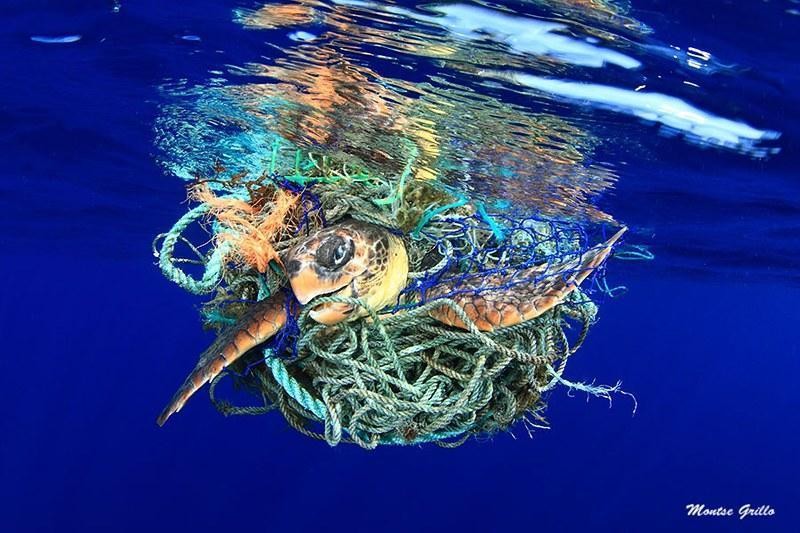
Loggerhead sea turtle (Caretta caretta) entangled in a dense mass of discarded fishing nets and ropes. Photograph by Montse Grillo
On the other hand, feeding is another human-driven behaviour that is having a direct impact on turtles. Although often promoted as a harmless tourist activity, feeding wild animals in their natural habitat is actually prohibited in many countries, including Spain, as it represents direct interference with wildlife (MITECO, 2022; Monzón-Arguello et al., 2018). Unfortunately, these regulations are not always enforced.
In the Canary Islands, this practice typically occurs in coastal areas, where dive centres and tour operators offer food to turtles and other marine animals to ensure sightings. Over time, this artificial feeding changes the turtles’ natural behaviour. They start depending on unnatural food sources, and remain in areas with high human activity, where the risks of collisions, disease, and contact with marine debris are considerably higher (Hurtado-Pampín et al., 2024; Innoceana, 2023).
Research shows that turtles that are regularly fed by humans develop altered behaviour, atypical growth patterns, and present blood biochemistry changes linked to stress and poorer health (Monzón-Arguello et al., 2018).
This activity may also be related to the shift towards neritic habitat use observed in Tenerife, where juvenile turtles may not be following their natural migratory patterns and instead remain around the islands for longer periods.
What can we do to help protect loggerhead turtles?
The good news is that everyone can be part of the solution. While active surveillance is needed to prevent feeding at recreational centres and during tourist excursions, the public also has a key role to play, choosing responsible activities that respect wildlife and reporting inappropriate practices to the authorities.
Also, targeted education and awareness programs for the fishing community could help reduce loggerhead turtle mortality by discouraging the abandonment of fishing gear and promoting responsible fishing practices, thereby minimizing the risk of entanglement and associated injuries or death.
Loggerhead turtles will continue to arrive in the Canary Islands, as they have for centuries. It is our responsibility to ensure that they live without human disturbances that put their survival at risk.
Bibliography:
Bibliography
Bjorndal, K. A., Bolten, A. B., & Martins, H. R. (2000).
Somatic growth model of juvenile loggerhead sea turtles Caretta caretta: duration of pelagic stage. Marine Ecology Progress Series, 202, 265–272.Brost, B., Witherington, B., Meylan, A., Leone, E., Ehrhart, L., & Bagley, D. (2015). Sea turtle hatchling production from Florida (USA) beaches, 2002-2012, with recommendations for analyzing hatching success. Endangered Species Research, 27(1), 53-68.
Casale, P., & Marco, A. (2015).
Caretta caretta (North East Atlantic subpopulation), Loggerhead Turtle. The IUCN Red List of Threatened Species.
http://dx.doi.org/10.2305/IUCN.UK.2015-4.RLTS.T83776383A83776554.enD’Ilio, S., Mattei, D., Blasi, M. F., & Alimonti, A. (2011).
The occurrence of chemical elements and POPs in loggerhead turtles (Caretta caretta): An overview. Marine Pollution Bulletin, 62(8), 1606–1615.
https://doi.org/10.1016/j.marpolbul.2011.05.022Gall, S. C., & Thompson, R. C. (2015). The impact of debris on marine life. Marine Pollution Bulletin, 92, 170–179. https://doi.org/10.1016/j.marpolbul.2014.12.041
González, J. M., Anastácio, R., Lizárraga-Cubedo, H. A., & Pereira, M. J. (2020).
Caretta caretta nesting activity on Akumal Beaches, Mexico. Scientific Reports, 10(1), 3020.Hurtado-Pampín, C., De la Cruz-Modino, R., & Hernández, J. C. (2024).
Sea turtle stranding records and fishing interactions on an Oceanic Atlantic Island (Tenerife, Canary Islands). Journal of the Marine Biological Association of the United Kingdom, 104, e82.
https://doi.org/10.1017/S0025315424000638Innoceana. (2023).
Interacciones de la pesca artesanal y buceo con especies protegidas de Canarias – Interespecies. Actividades 3 y 4.International Union for Conservation of Nature (IUCN). (2007).
Caretta caretta. The IUCN Red List of Threatened Species 2007: e.T3897A10133884.Martins, S., Patrício, R., Clarke, L. J., de Santos Loureiro, N., & Marco, A. (2022).
High variability in nest site selection in a loggerhead turtle rookery, in Boa Vista Island, Cabo Verde. Journal of Experimental Marine Biology and Ecology, 556, 151798.McClellan, C. M., & Read, A. J. (2007).
Complexity and variation in loggerhead sea turtle life history. Biology Letters, 3(6), 592–594.
https://doi.org/10.1098/rsbl.2007.0355Ministerio para la Transición Ecológica y el Reto Demográfico. (2022).
Estrategia para la conservación de la tortuga común (Caretta caretta) y otras especies de tortugas marinas en España.Gobierno de España.Monzón-Arguello C., Rico C., Carreras C., Calabuig P., & Marco A., Lopez-Jurado L. F. (2009). Variation in spatial distribution of juvenile loggerhead turtles in the eastern Atlantic and western Mediterranean Sea. Journal of Experimental Marine Biology and Ecology, 373(2), 79-86. https://doi.org/10.1016/j.jembe.2009.03.007.
Monzón‑Argüello, C., Cardona, L., Calabuig, P., Camacho, M., Crespo‑Picazo, J. L., García‑Párraga, D., … & Varo‑Cruz, N. (2018). Supplemental feeding and other anthropogenic threats to green turtles (Chelonia mydas) in the Canary Islands. Science of the Total Environment, 621, 1000–1011. https://doi.org/10.1016/j.scitotenv.2017.10.126
Nelms, S. E., Duncan, E. M., Broderick, A. C., Galloway, T. S., Godfrey, M. H., Hamann, M., Lindeque, P. K., & Godley, B. J. (2016).
Plastic and marine turtles: a review and call for research. ICES Journal of Marine Science, 73(2), 165–181.
https://doi.org/10.1093/icesjms/fsv165Kanjer, L., Filek, K., Mucko, M., Lupić, M. Z., Frleta‐Valić, M., Gračan, R., & Bosak, S. (2024). Growing older, growing more diverse: Sea turtles and epibiotic cyanobacteria. Journal of phycology, 60(6), 1390-1405.
Schuyler, Q., Hardesty, B. D., Wilcox, C., & Townsend, K. (2013).
Global analysis of anthropogenic debris ingestion by sea turtles. Conservation Biology, 28(1), 129–139.
https://doi.org/10.1111/cobi.12126Tortosa García de Ceca, M. (2021).
Plastic ingestion in juvenile loggerhead sea turtles (Caretta caretta) stranded in Tenerife, Canary Islands. Master’s thesis, Universidad de La Laguna.Wallace, B. P., DiMatteo, A. D., Hurley, B. J., Finkbeiner, E. M., Bolten, A. B., Chaloupka, M. Y., … & Mast, R. B. (2010) Regional management units for marine turtles: A novel framework for prioritizing conservation and research across multiple scales. PLoS ONE, 5(12).
https://doi.org/10.1371/journal.pone.0015465Witherington, B., Hirama, S., & Hardy, R. (2012).
Young sea turtles of the pelagic Sargassum-dominated drift community: habitat use, population density, and threats. Marine Ecology Progress Series, 463, 1–22.